What I Learned at the Oklahoma AI Roundtable Summit This Week
By Adam Coury
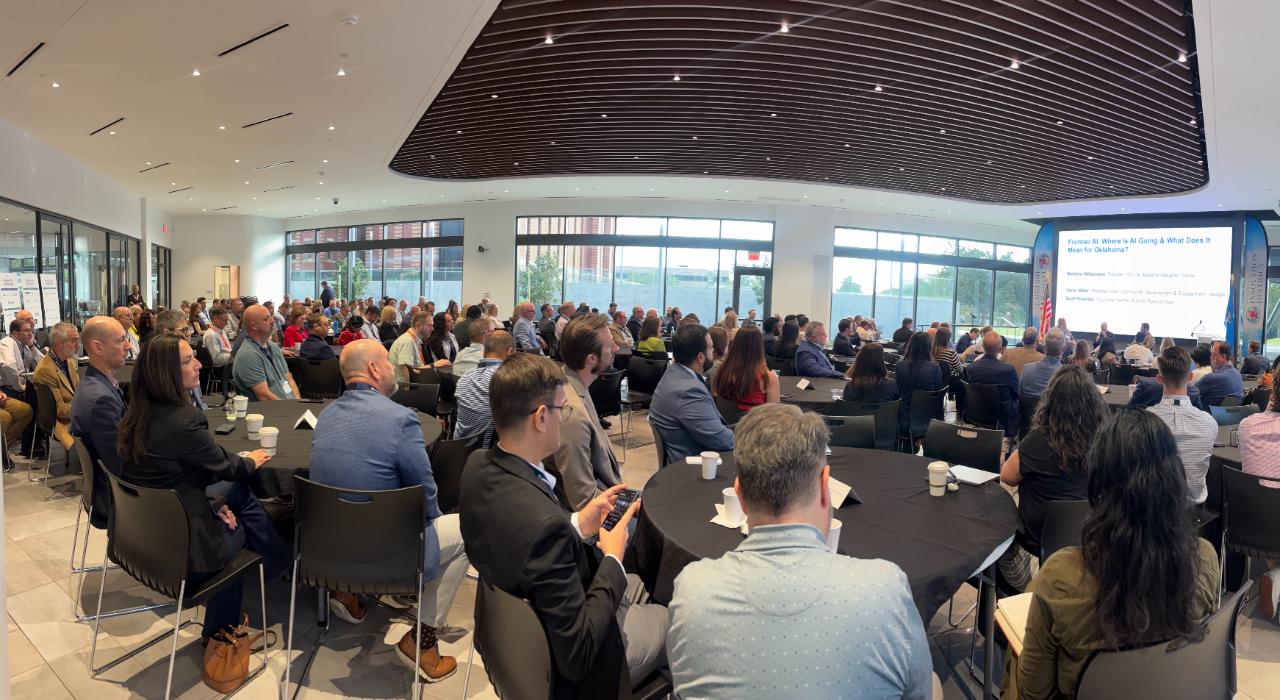
I attended the Oklahoma AI Roundtable Summit this week as one of the founding members, and I need to tell you what happened in that room. We expected maybe 15 people. We got 240. The energy was electric. Google's been pumping $9 billion into Oklahoma. Meta has a data center in Tulsa. OG&E is running a 1.2-gigawatt Google deal. And nobody outside the state knows it.
I attended the Oklahoma AI Roundtable Summit this week as one of the founding members, and I need to tell you what happened in that room.
We expected maybe 15 people. We got 240. The energy was electric. Google's been pumping $9 billion into Oklahoma. Meta has a data center in Tulsa. OG&E is running a 1.2-gigawatt Google deal. And nobody outside the state knows it. That's the story that kept surfacing all day—Oklahoma is quietly becoming a national AI hub, and we're under-telling it.
But there were some big impact statements and moments that stuck out to me throughout the day.
The most important one was simpler than all the rest: AI adoption is already happening in your organization right now. You may not know it yet. But it is. And if leadership isn't shaping how it's used, then your people are already deciding for you.
An accountant is writing SQL scripts with ChatGPT—no IT department involved. A plant floor engineer independently built a ChatGPT program to track instrumentation. Eighty-five percent of students and 90% of teachers are already using AI tools. The technology didn't ask permission to enter your organization. It just showed up. The question isn't whether it will arrive. The question is whether you'll lead the conversation about what responsible use looks like—or whether you'll find out after the fact that your team has already made those decisions without you.
WHAT THIS COSTS
Here's what happens when leadership doesn't get ahead of AI adoption:
First. You lose control of how the tool is used. When adoption is grassroots and unsupervised, people are solving problems in isolation. Someone builds a workaround in one department that contradicts policy in another. Data governance becomes whoever-has-access. Your organization becomes a patchwork of different tools, different standards, and different risk postures—all solving the same problem seven different ways.
Second. You expose yourself to liability before you even know it exists. Ty, Oklahoma's Chief AI and Technology Officer, laid this out clearly: the cost of deploying technology per dollar spent has grown from $3-4 per $1 of tech spend a decade ago to $8-10 today—and it's still rising. That's because governance, compliance, and risk management are now the lion's share of the cost. Organizations without clear AI policy are racking up invisible debt. When regulators show up or an error surfaces, you're not just fixing a tool problem. You're fixing a leadership problem.
Third. You can't scale what you can't govern. Alan from LSB said something that stayed with me: large-scale ERP systems are nearing the end of their era. The next architecture will be agentic AI with human oversight. But you can't hand an agent $1 million in decision authority if you haven't established what good judgment looks like in your organization first. Governance has to come before tools. Not after.
WHAT THE BEST OPERATORS DO
The leaders I heard from this week—state CIOs, enterprise CIOs, legislators, and technology executives—all moved the same way:
They lead with governance, not technology. The State of Oklahoma achieved a 91% AI policy compliance rate by making tool access contingent on compliance. They don't default to whatever Microsoft wants to sell them. They maintain an expanding and contracting whitelist matched by risk level, use case, and budget. Every vendor—from five-person firms to 50,000-person organizations—has to meet NIST AI Risk Management Framework standards before deployment. That's not bureaucracy. That's stewardship. You don't need a 200-page policy. You need a clear one-page answer to: what does responsible use look like in my organization?
They use the tool personally before they guide anyone else through it. Brad from Ascent Resources was blunt about this: leaders cannot credibly guide their organization through AI adoption without firsthand experience. This came up in every single session—from enterprise to education to government. The fastest action any leader can take right now is to start actually using the tool that you want your team to use. When your people ask "is it okay to use this?", you need to have already used it yourself.
They plan for workforce investment at 2-3x the technology budget. Ty's research was clear: the ratio has shifted. It's no longer about buying the best tool. It's about investing in the people who will use the tool well. If your budget is 70% technology and 30% people, you're inverted. The organizations scaling AI successfully are spending 70% on training, change management, and people—and 30% on tools.
They understand that adoption is faster than strategy. Every panelist acknowledged it: AI is moving faster than any technology cycle in history. Three-to-five-year strategic plans are already obsolete. Effective strategy now operates in months. The organizations that wait for a perfect plan will be governed by the employees who didn't wait. You don't need a perfect plan. You need a decision, and you need it now.
They recognize that infrastructure is the real foundation. The national security panel reframed AI as a physical problem first—energy, compute, and transmission—not a software problem. China invested $300 billion more than the US in energy for 2025 alone. The race for AI dominance will be won or lost on infrastructure, not on clever algorithms. That matters for Oklahoma because we're positioned better than almost any state in the nation. But it also matters for your organization: before you scale AI in your business, make sure your infrastructure can handle it. That means data storage, processing power, and connectivity—not just access to the tool.
WHY WE'RE ENCOURAGING THIS METHODOLOGY
This is why we're encouraging our clients to adopt this framework right now—so that AI doesn't get ahead of you. So that you're not scrambling to bolt governance on after your team has already built inconsistent, undocumented, risky workflows. So that when adoption happens—and it will—you're the one leading it instead of reacting to it.
We're helping companies create a game plan on how to use AI to make sure that it pays back. Not every tool. Not every use case. Strategic deployment tied to outcomes. We're helping organizations train their workforce to amplify, not replace people—so that when you introduce an AI tool, your team gets smarter and faster, not afraid of losing their job. We're helping companies choose a unified layer of AI so adoption doesn't spiral out of control into chaos. One or two approved tools, clear governance, consistent training—instead of 15 different AI experiments happening in the dark.
In each case, the pattern is the same: governance first. Tools second. People third. That's the opposite of how most organizations approach it. And it's why the organizations that move now won't be cleaning up the mess later.
FIVE MINUTE APPLICATION
Here are three questions to ask yourself this week:
-
Do I know where AI is already being used in my organization? Have I asked my team directly what tools they're using and why?
-
Have I personally used a compliant LLM on a real work problem? Not a demo. Not a safe test. A real problem.
-
If someone on my team asked me "is it okay to use this tool for this task?", could I answer with a clear policy in the next five minutes?
Now here's the conversation to have this week: sit down with your leadership team and ask them: "What does responsible AI use look like for us?" Don't make it a compliance exercise. Make it a values exercise. One page. Five bullet points. What matters to us? What's off limits? What do we need to know before we approve a tool?
Then—and this is the part that matters—use it personally. Open the compliant LLM you have within your organization. Give it a real task from your week. Notice what it does well. Notice what it gets wrong. Notice how you feel about handing it a decision. That feeling is your leadership intuition telling you something. Listen to it.
Oklahoma is becoming the national AI hub. The infrastructure is here. The talent is here. The energy is here. But the story that will define the next decade isn't about data centers and gigawatts. It's about leaders who got ahead of the curve—who shaped adoption instead of reacting to it. Be one of them.
The next Oklahoma AI Roundtable is coming to Tulsa. Breakout sessions by industry. A statewide community. Expanded reach to rural Oklahoma. The conversation is just beginning. And it starts with you deciding: am I going to lead this, or am I going to follow?
This framework is what we have been encouraging our clients to use for the past year. Get ahead of the AI conversation before the AI conversation happens without you.
WHAT'S NEXT FOR US
I'll be in San Francisco this week at the Supabase Select Conference alongside leaders from Supabase, Apple, Anthropic, ChatGPT, Y Combinator, Replit, and Lovable. The conversation there is the same one we're having here—how AI is being used and governed internationally, the security risks that come with rapid adoption, and how your organization can start using this technology to amplify your team rather than replace it. That's the work we're doing. That's the question we're answering for you.
If you want to have a deeper discussion on how this applies to your organization or your team, just message us. We're here to help you move from confusion to clarity.
Leadership isn't about having all the answers about AI. It's about asking the right questions before your team answers them without you.