Operations Before Expansion — This Week's Leadership Insight
By Adam Coury
You're standing on a job site watching your team execute flawlessly. The work is clean. The crew knows what they're doing. And your phone won't stop buzzing with new opportunities—another market, another service line, another partnership that could "really scale things." So you say yes. You bring in the new people, add the new offering, chase the new market. Six months later, your invoicing is broken.
You're standing on a job site watching your team execute flawlessly. The work is clean. The crew knows what they're doing. And your phone won't stop buzzing with new opportunities—another market, another service line, another partnership that could "really scale things."
So you say yes. You bring in the new people, add the new offering, chase the new market. Six months later, your invoicing is broken. Your guys are confused about who reports to whom. Your best crew lead just quit because nobody knows what his actual role is anymore. You grew revenue, but you lost something harder to rebuild than money: clarity.
This is the pattern showing up everywhere right now. Growth that outpaces foundation. Expansion that compounds the problems you already have instead of solving them.
WHAT THIS COSTS
When you build on top of broken systems, every new layer makes the break worse.
First. You burn out your best people. They're executing on sheer talent and work ethic, but they're also carrying the weight of unclear roles, conflicting priorities, and processes that don't work. Your best operators see the dysfunction. Some will leave.
Second. You create hidden financial leaks. A broken invoicing process means money sitting uncollected. Undefined roles mean duplicate work—two people doing the same thing or nobody doing critical things. You think you're scaling revenue, but margin is disappearing into the cracks. If your plans don't include clarity on how money actually moves through the business, you're working blind.
Third. You lose the ability to onboard and develop people. New hires walk into ambiguity. They don't know what winning looks like. They don't know who to ask. They don't know if they're doing the job right. The system can't replicate itself. You become the bottleneck, and one person is not a scalable business model.
WHAT THE BEST OPERATORS DO
The operators who are actually growing—not just adding headcount and chaos—they're doing something different. They're treating foundation as a parallel track to growth, not something you build after you've already expanded.
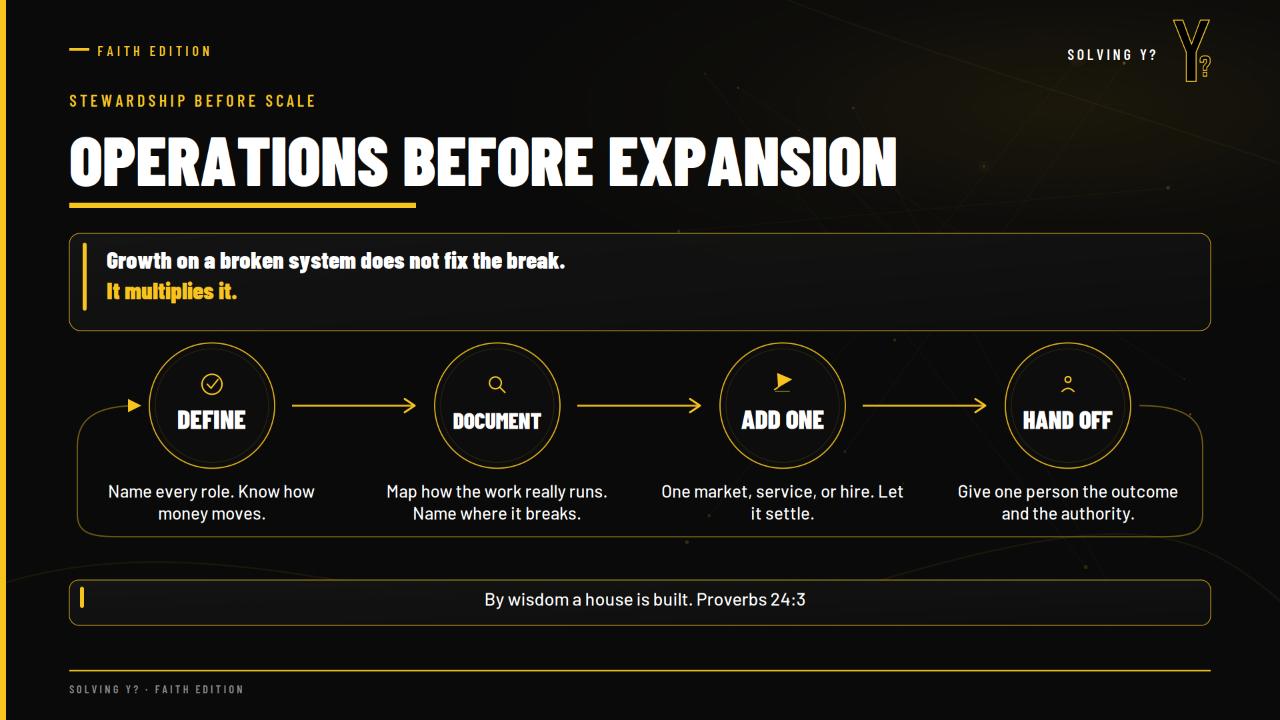
Freeze expansion until the basics are locked. Define your core roles with absolute clarity. Write down what each person is accountable for. Make decisions about your financial process—how money comes in, how it gets tracked, how it gets out. This is not bureaucracy. This is discipline. That discipline starts with knowing your own house.
Document the way you actually work right now. Not the way you think you work. The actual way. What does a typical job look like from start to finish? Who touches it? Where does information live? Where does it break? You can't fix what you won't name. Once you see it, you can simplify it.
Add one thing, not everything at once. Pick the one new service, one new market, or one new team member. Get that locked in. Let your systems absorb it. Then add the next thing. Slow scaling is boring. It's also the only scaling that actually sticks.
Make one person responsible for the outcome, not for doing all the work. Delegation isn't abdication. It's naming someone and saying "this is yours now—you own the result." Give them the authority to make decisions and the clarity to know what winning looks like. Real delegation means you organized people, named leaders, and held them accountable to the vision.
5 MINUTE APPLICATION
-
What is the one foundational gap in your operation right now that's the biggest drag on growth? (Invoicing? Roles? Onboarding? Client handoff?)
-
What new initiative are you considering that might get piled on top of that gap?
-
What would it cost to pause the new thing for 90 days and fix the foundation instead?
Have a conversation this week with your leadership team. Ask them: "What's one thing we're doing that's slowing us down that nobody's talking about?" The honest answer is always there. You just have to ask it.
The hard work is doing the foundational work when there's money on the table to chase. That's the way you build something that lasts.