Leading Change: Close the Consistency Gap
By Adam Coury
LEADING CHANGE AFTER THE DECISION CLOSE THE CONSISTENCY GAP A decision announced is not a decision landed. Stay present until behavior changes. You make a good decision. Clear, necessary, the right move. You communicate it. Everyone nods. Two weeks later, nothing has changed. The same bottleneck is still there. The same behavior. The same problem. This is the consistency gap. It's not that your strategy is weak.
LEADING CHANGE
AFTER THE DECISION
CLOSE THE CONSISTENCY GAP
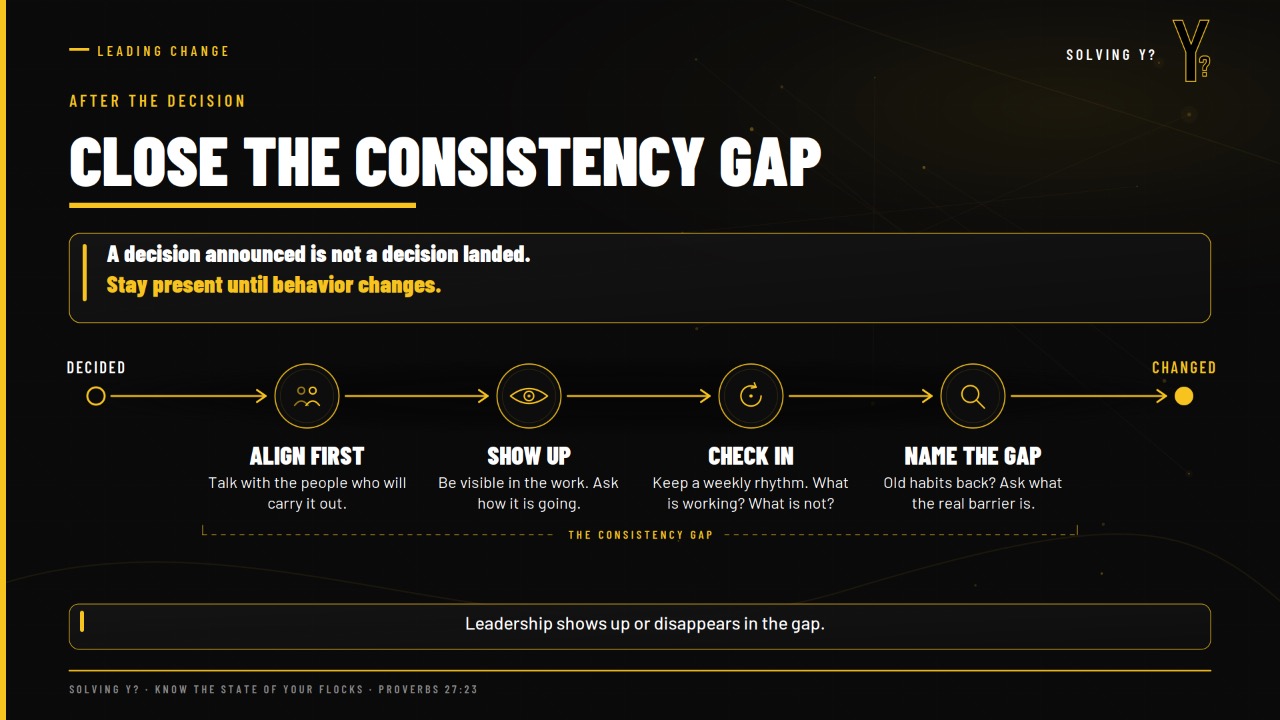
A decision announced is not a decision landed. Stay present until behavior changes.
You make a good decision. Clear, necessary, the right move. You communicate it. Everyone nods. Two weeks later, nothing has changed. The same bottleneck is still there. The same behavior. The same problem.
This is the consistency gap. It's not that your strategy is weak. It's that leadership stopped when the decision was announced. You decided. Then you disappeared from the execution.
Proverbs 16:3 says, "Commit to the Lord whatever you do, and he will establish your plans." Establishment isn't automatic. It requires a leader to stay present through implementation, not just present when the decision was made.
WHAT THIS COSTS
When leadership disappears after deciding, people don't know if you meant it.
First. Execution fractures. Half your organization heard the decision; half didn't. The other half heard it wrong. Confusion becomes your operating system, and competing versions of the truth run parallel.
Second. Your team stops believing decisions matter. If leadership doesn't follow up on it, why should they change? Trust in your leadership direction collapses.
Third. You waste energy re-deciding the same thing instead of leading people through change. The same conversation happens three times because leadership never showed up to reinforce it from announcement to reality.
WHAT THE BEST LEADERS DO
Leaders closing this gap don't just decide better. They lead through the implementation, not just through the announcement.
Align first. Talk with the people who will carry it out. Not to get permission. To understand what they need to actually move. This is where the decision gets real.
Show up. Be visible in the work. Ask how it's going. Reinforce the new direction. Proverbs 27:23 says, "Know the state of your flocks." Leaders know whether a decision actually changed behavior or just became a memory.
Check in. Keep a weekly rhythm. What's working? What's not? What's blocking? Be the steady presence that tells people this matters, and you're here to make sure it sticks.
Name the gap. When behavior reverts to the old way, call it out. Not as blame. As leadership clarity. "I see we're still doing X. We decided on Y. What's the real barrier?" This is where leadership teaches culture through consistency.
5 MINUTE APPLICATION
-
Name one decision you announced in the last month that hasn't visibly changed behavior.
-
When did you last personally check whether it landed? Not delegated it. You checked.
-
This week, show up in that work. Ask one team member: "Here's what we decided. What's actually changing?" Then listen for the real answer.
James 1:22 says, "Do not merely listen to the word. Do what it says." Leadership is the same. Decide, then lead people through the change. The gap between decision and reality is where your leadership either shows up or disappears.