I Spent the Weekend at Y Combinator — Here's What the Future Actually Looks Like
By Adam Coury
I have been saying for two years that we are not in an AI adoption wave. We are in an infrastructure rebuild. This weekend at Y Combinator in San Francisco confirmed it in ways I did not fully anticipate. Supabase Select 2026. Two days. Ten sessions. Sixty hackathon teams. Steve Wozniak closing the night. And a room full of people who are not waiting to see where AI goes — they are deciding where it goes. Here is what I saw, what I built, and what we are doing about it.
I have been saying for two years that we are not in an AI adoption wave. We are in an infrastructure rebuild. This weekend at Y Combinator in San Francisco confirmed it in ways I did not fully anticipate.
Supabase Select 2026. Two days. Ten sessions. Sixty hackathon teams. Steve Wozniak closing the night. And a room full of people who are not waiting to see where AI goes — they are deciding where it goes.
Here is what I saw, what I built, and what we are doing about it.
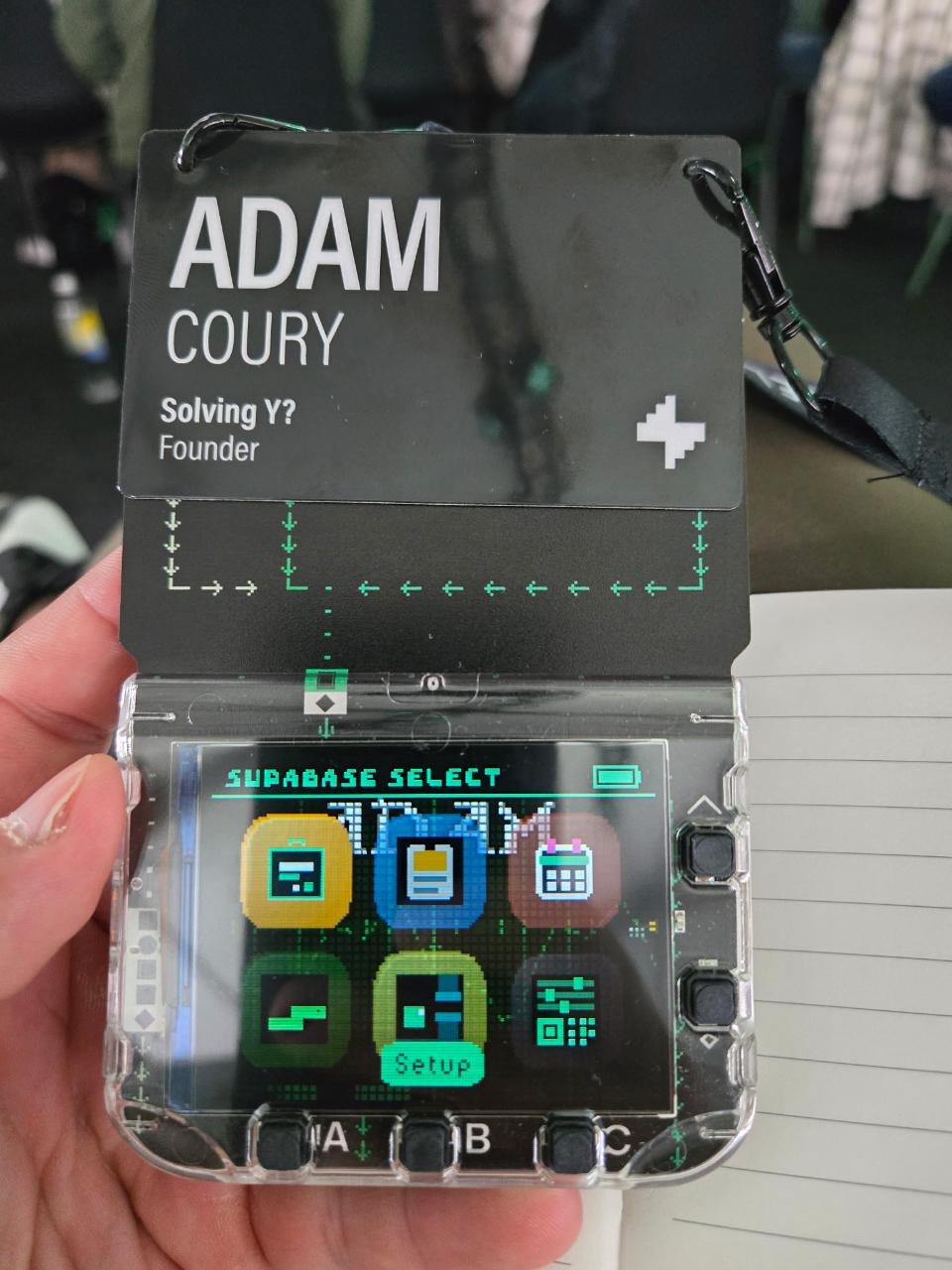
DAY 1 — SUPABASE SELECT CONFERENCE
1. The Entire Platform Is Being Rebuilt for Agents
Paul Copplestone, CEO and co-founder of Supabase, opened the keynote with a line that reframed everything: "We've spent 6 years building the world's best developer experience, but we need to build for our newest type of user: agents." Agents don't use dashboards. They are code-first and Git-native. So Supabase rebuilt for that.
The scale of where they are: 13 million builders on the platform, approaching 45 million managed Postgres instances, used by 1,700 plus Y Combinator companies including 60% of the most recent batch. New integrations announced with Stripe, ChatGPT, xAI Grok, and Google Gemini — all pointing in the same direction. Every major AI platform is now routing into Supabase because agents need a backend, and Supabase is becoming the default.
The first major technical release: Declarative Schemas powered by pgDelta — a tool that converts your entire database structure into code files with one command. Tables, views, comments, all of it. Why it matters: agents reading long migration histories hallucinate. pgDelta eliminates that. One command, everything in code, 100% open source and compatible with any Postgres database. This is not a developer convenience feature. It is infrastructure designed for a world where agents are making and reviewing database changes.
They also rebuilt the CLI from the ground up: 9x faster cold starts, 90% less idle memory, 5x smaller download, no Docker dependency, and native multi-agent support. Previously, running a second local instance caused port conflicts. Now parallel agents and Git worktrees work natively. The CLI is being rebuilt because agents use it — not humans.
Then they announced Supabase Compute — serverless infrastructure with no timeouts, any runtime, co-located with the database inside the same private network, less than 10ms from the database, idle billing only. The origin story: Gary Tan was building GBrain and emailed Paul directly — "Supabase Edge Functions are the obvious choice, but the 2-second limit is a big downside and it might force me to add a server elsewhere." That email became a product. That is how fast this ecosystem moves.
Paul's mandate for the entire company: "All of Supabase needs to be managed in code. The Supabase folder needs to be the source of truth. Users should be able to push to a Git remote and everything updates." This is the direction. Agents don't use dashboards. If your platform is not Git-native, you are building for humans in an age of agents.
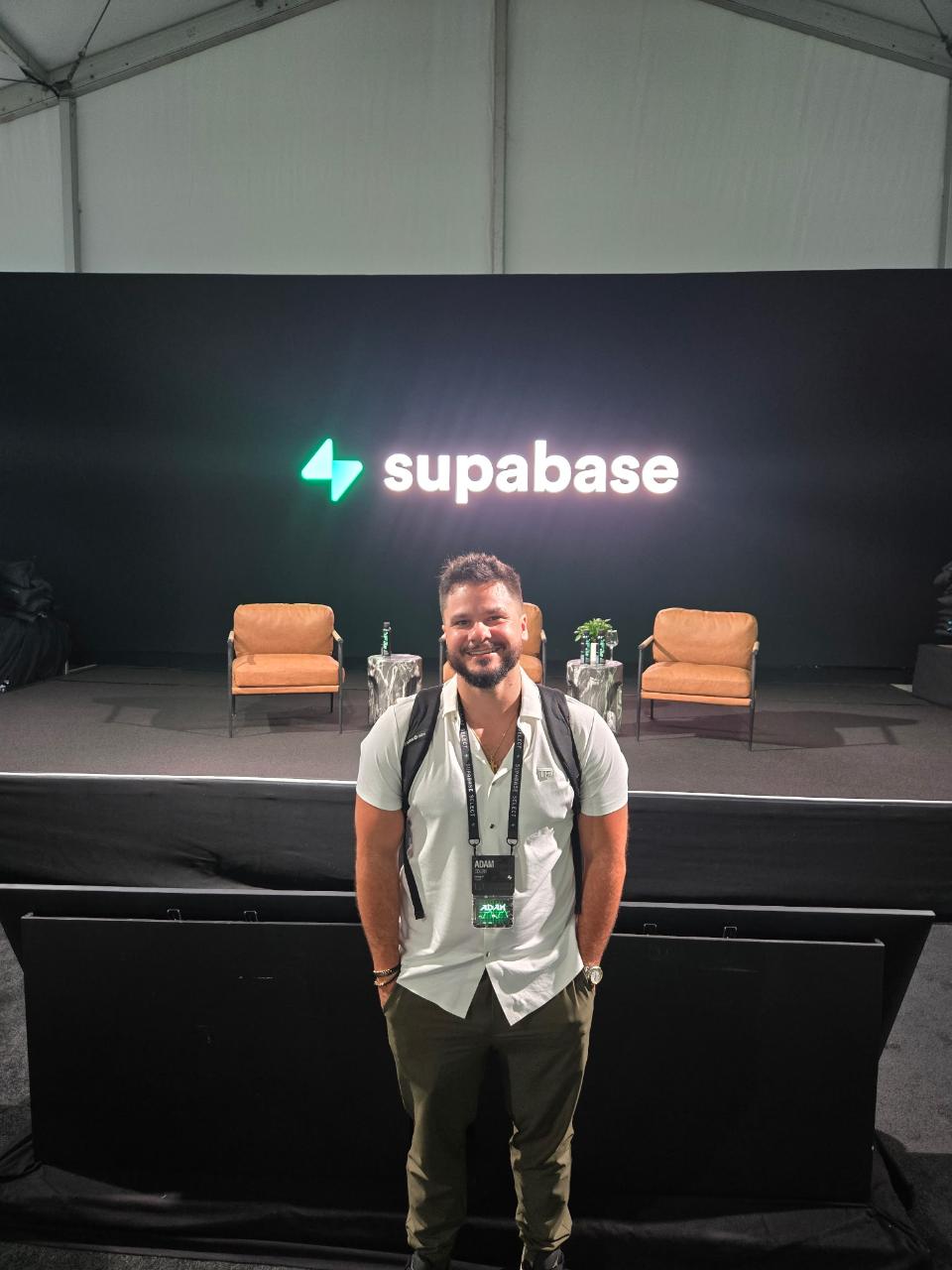
2. Andrew Ng Said the Quiet Part Loud About Learning and AI
Andrew Ng — founder of DeepLearning.AI, co-founder of Coursera, former founding lead of Google Brain, Stanford professor — sat down with Paul for a fireside chat. He was direct about things most people in AI are avoiding.
On agents and infrastructure: "I feel like right now the world is going through a massive data center buildup. A lot of core infrastructure will be used not just by humans but by agents. Agentic usage will drive massive demand." Your database today is sized for human query rates. Agents will destroy that assumption.
He shared his team's skills map — built from 10,000 plus job descriptions and dozens of structured interviews — on what actually makes a great AI engineer today. Four things: the ability to build and deploy AI applications while handling uncertainty and running disciplined eval loops; software engineering fundamentals, because developers who understand trade-offs steer agents far better; using coding agents, the fastest-changing skill, shifting every three to six months; and shaping the build — having product instinct and deciding what to actually build. His conclusion: "As building has become easier, the bottleneck is less building but deciding what to build."
The most uncomfortable part of his talk: chatbots are terrible for learning. Rigorous studies now confirm students who use LLMs do better on homework and worse on final exams. "The vast majority of ways the vast majority of people use LLMs does not result in learning." He is now building Learn Vector — not a course platform, a frontier human development lab focused on personalized one-to-one learning, funded by Google.
And he said something I have not stopped thinking about: "Before AI, we had a list of projects we wanted to work on but couldn't finish. Now my list has gotten way longer even as AI supposedly made us more productive."
3. Gary Tan, Michael Seibel, and the New Org Chart Nobody Is Talking About
Gary Tan runs Y Combinator. Michael Seibel is a YC Managing Director and co-founder of Twitch. Both sat down with Paul for a session on org design, remote work, and what AI actually changes at the organizational level.
The headline: companies approaching parity in revenue with order-of-magnitude differences in headcount. Gary sat in office hours with a company doing $15 million in revenue — two nineteen-year-olds. Michael's line: "If you can generate billions of dollars of revenue at 100 people, there are skill sets you don't need. You don't need someone who managed 1,000 people at Amazon."
On remote work: Supabase runs 450 people across 75 countries with everything pushed to public Slack channels so different time zones can answer. Teams operate like independent startups — most senior person they could find, given full autonomy. Michael was blunt: "This is fashion. Brex got rid of all their offices and bragged about it. Then everyone flip-flopped. I think it's cargo culting — who do you want to be like?"
On what AI should not do: Michael does not use AI for founder interviews or office hours. "If I'm doing that, then I'm bad at my job." Gary does not use it for their YouTube videos. "You can tell when something is a little too AI-voiced." Michael's most important point of the session: for a San Francisco police recruiting project, nothing worked until he went in person. "When people think you give a ****, everything changes."
Gary built GBrain — half a million Markdown files, his entire life in a RAG system — and agents now watch his Slack and alert him within 30 seconds of a crisis at any of his portfolio companies. He is running it all with TypeScript and Markdown files. Not because it is trendy. Because it works.
4. The Storage Engine Problem Nobody Talks About Until It Destroys Your Database
Reality check first: 78% of terabyte-scale Supabase databases started under 100MB. Most started around 70MB. Typical large databases grow 6x in one year. The scale problems people think are distant are closer than they realize.
The core problem is Postgres heap storage. It has not meaningfully changed in 30 years. Every update leaves behind a dead row version that occupies space until vacuum cleans it. Vacuum competes with your queries, slows the database, and on high-update tables can run for days. If it falls behind, transaction ID wraparound puts the database in read-only mode. This happened to Sentry in 2015. It happened to Mailchimp in 2019.
OrioleDB replaces the storage engine entirely — no vacuum needed, uses an undo log instead, 64-bit transaction IDs, and row-level WAL so you only replicate what actually changed instead of entire 8KB blocks. 2x faster on the TPC-C industry benchmark. 100% open source under Apache 2.0.
Multigress solves the multi-node coordination problem. Every existing high-availability tool has conditions under which it can lose data. Multigress holds all in-flight transactions on primary failure, promotes a replica, completes those transactions against the new primary, then spins up a new replica. Tested across 1,000 sequential failovers with zero data loss. Released fully open source today.
Supabase Spark is the long play — built for a world of billions of databases, one per agent, one per user, one per idea. This is not incremental improvement. This is a full rearchitecture of what a database is and who it serves.
5. OpenAI, Anthropic, and the Line That Does Not Move
The OpenAI infrastructure team made one point every leader reading this needs to write down: stop measuring price per million tokens. The real metric is cost per task — total tokens to solve the problem, including tool calls, database reads, and latency. The models that win are not the ones with the cheapest tokens. They are the ones that solve problems with the fewest steps.
They also announced DOTS — OpenAI's always-on agent, designed as a virtual coworker, not a personal assistant. Always watching Slack, email, and the internet. Proactively identifying what matters. Firing off background agents to check on projects across your entire organization. Proactivity is the next major unlock, and they said to expect a significant push in the next three months.
The Anthropic team was equally direct. On giving agents direct database access: "It's probably a bad idea. In a toy environment, totally fine. But the moment you want to consider it seriously, don't do that." Their hiring shift: no more leetcode. Candidates now work with Claude Code and coding agents in interviews. The role of a developer is changing in real time, and the companies that understand that will hire and build differently.
6. Steve Wozniak Closed the Night
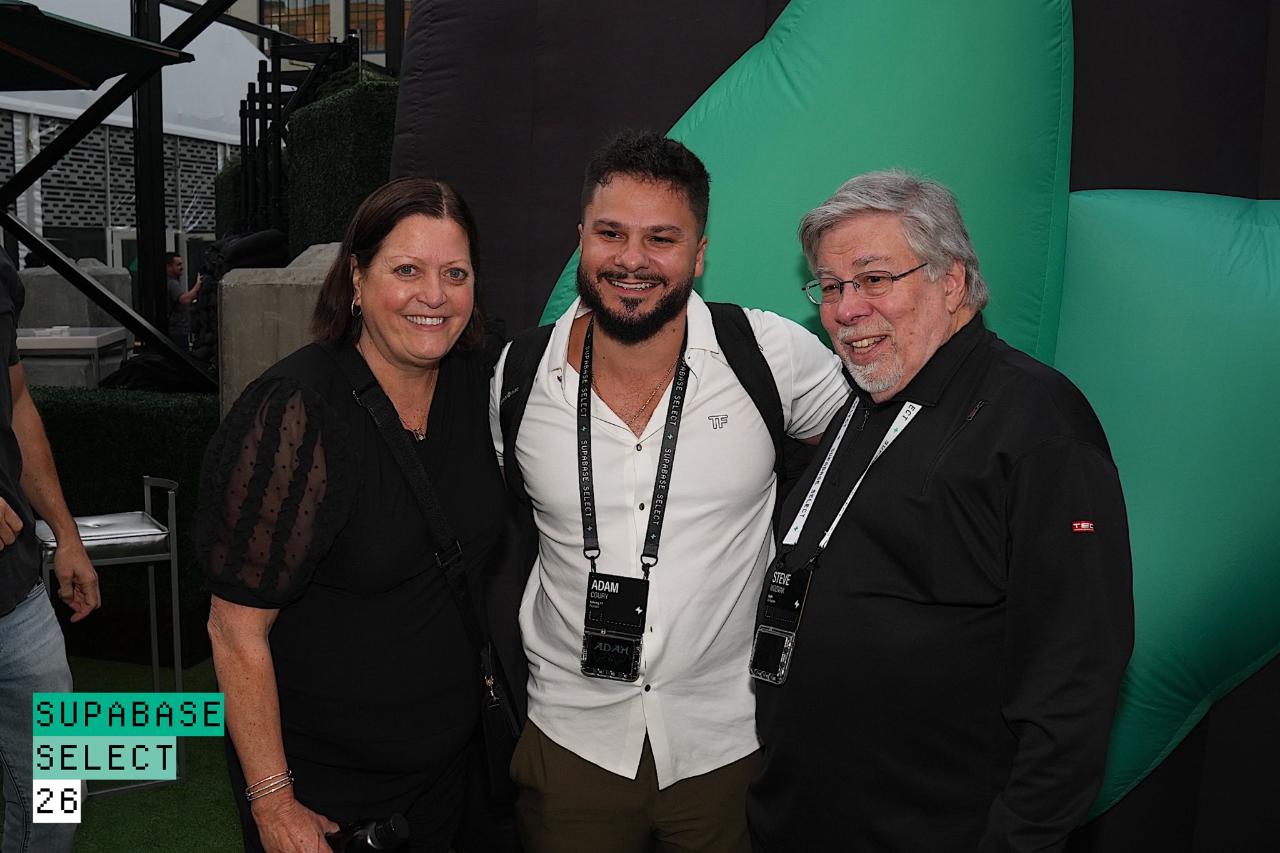
Woz is still technically an Apple employee — the only person who has received a paycheck every week since Apple started. He designed the Apple I and Apple II entirely alone, from scattered chip manuals and journals, with no books, no classes, and no internet. He would go to sleep thinking about how to cut his chip count from 78 to 76.
He does not use AI for coding. He does not plan to. His concern was not productivity — it was ownership. "For the first 20 years, you bought something and it was yours. Then cloud-based services came, and now you don't own things. They can make decisions that affect your use of that product. I'm against that."
His most memorable moment of the night: he discovered Postgres five to ten years ago and said "I felt so good about it." His parallel was explicit — Postgres is to Oracle what Apple was to IBM. "The little guys should have a place if they have enough brilliance to put it into effect. And Postgres is one of those words I never forget."
A room full of builders, and the man who designed the computer that started all of it, closed the night talking about why open platforms matter and why the little guys deserve a shot. It was a moment worth being in the room for.
DAY 2 — THE HACKATHON
I just wrapped up my first hackathon. 60 teams. 6 hours. One prompt: build something agents want.
I built an application called DYAD. A dyad is a pair — and that is the idea. An agent and its human are a team, and right now neither one can see how the other is doing. Your agent has no idea if you slept four hours. You have no idea if your agent is running stale or throwing errors.
DYAD gives both sides a shared set of vitals. I connected my Oura ring so my agent can see my readiness and sleep scores, HRV, resting heart rate, heart rate through the day, workouts, and activity. And the agent reports its own vitals back to me — its error, retry, and correction rates, its latency, how full its context window is, and how fresh it is.
With that shared signal, the agent knows when to push me, when to check in, and when to hold back and leave me alone. And I know when it is running well enough to trust with more.
DYAD did not make the finals. But being in that room — watching ideas go from zero to working product in six hours — was one of the most energizing experiences I have had. The ideas people came up with were genuinely mind-blowing.
Three things I walked away believing:
-
Voice will be the primary way you communicate with your agent. Not typing. Voice.
-
Agents will become proactive by default — not waiting to be asked, but looking for ways to help before you think to ask.
-
Agents will start communicating with other agents on your behalf — doing verification, coordination, and proactive work across people and systems without you in the loop at all.
Thank you to Supabase and Y Combinator for putting on something this well done and for building a product worth building on.
WHAT THIS MEANS FOR SOLVING Y? AND THE PEOPLE WE WORK WITH
I do not go to events like this to collect information. I go to figure out what we are going to build next and how we are going to serve our clients at a higher level.
Here is what we are taking home and putting to work.
Second Brain for the organizations we work with. Every company we are embedded in is sitting on years of knowledge, decisions, meetings, and context that lives inside people's heads and nowhere else. We are building structured second brain systems — not just for individual leaders, but for the organization itself. When someone leaves, the knowledge stays.
Building systems for agents, not just for people. The products and workflows we help our clients build can no longer be designed only for human users. Agents are going to be operating inside these systems. We are designing for that from the start.
Data security and database structure as a leadership conversation. Most of our clients have never had a real conversation about how their data is structured, who owns it, or what happens when an agent has access to it. This is not an IT conversation. It is a leadership conversation, and we are going to lead it.
Teaching our clients how to build their own agents. The competitive advantage in the next three years is not which AI tool you subscribe to. It is whether your team knows how to build agents that actually work inside your business.
MCP integrations and API education. Most of our clients are using LLMs through a chat window and leaving the majority of the value on the table. The companies that learn how to connect their existing tools directly into the models they are using will operate at a different level than the ones that do not.
And we are building something specifically for HumanAi users.
We are constructing an MCP server so that you can access your HumanAi notes, goals, tasks, and data directly through your agent — without ever logging into the platform. Your agent will know you the way HumanAi knows you. That is the direction we are heading, and this weekend confirmed we are building on the right foundation to get there.
The infrastructure is moving. The organizations that understand what is being built right now and start building toward it are going to have a significant head start on everyone else.
That is what this weekend was about.
We are just getting started.
— Adam