Half a Day Without Outlook: Three Lessons on Infrastructure
By Adam Coury
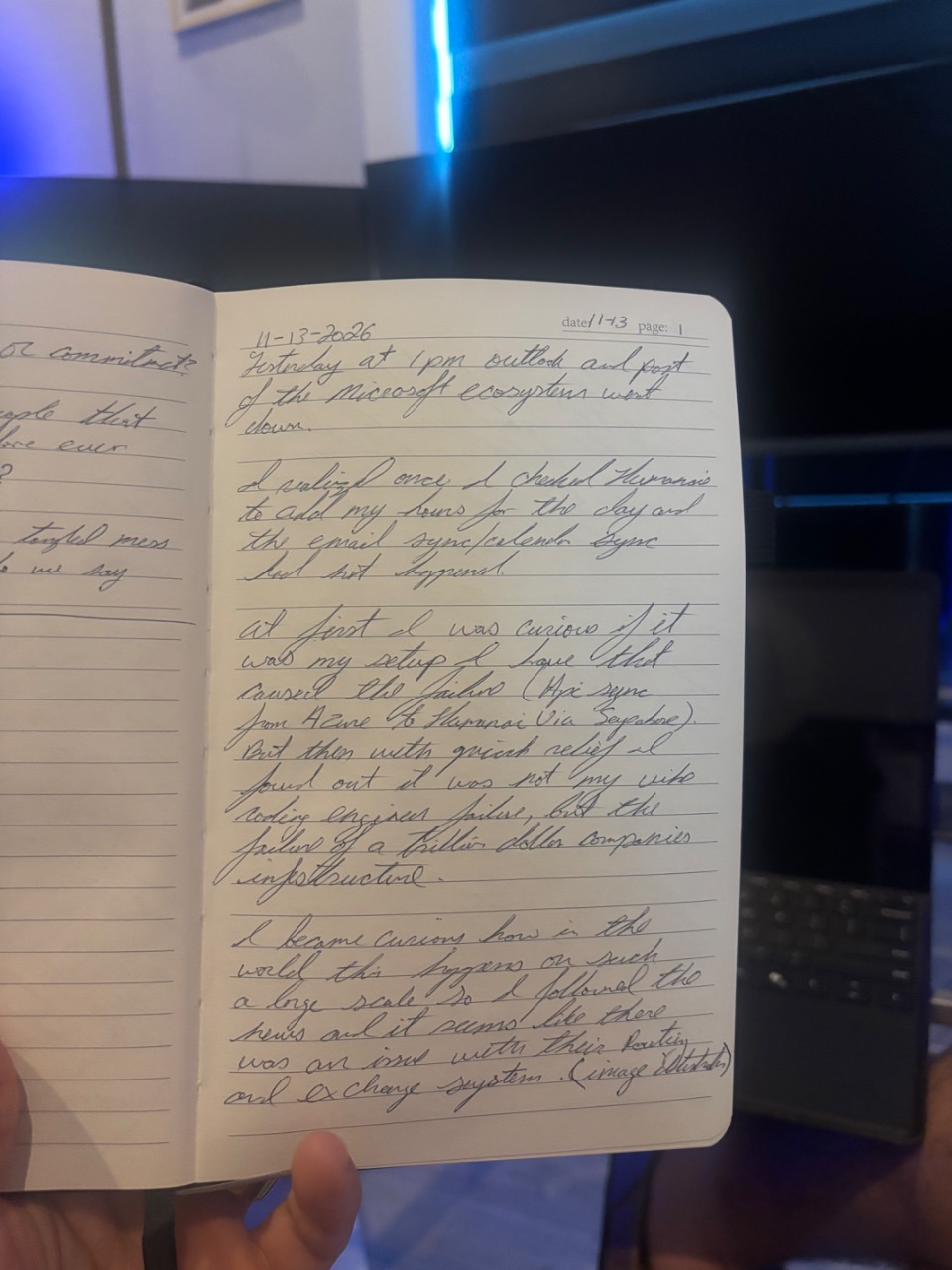
11-13-2026 Yesterday at 1 PM, Outlook and part of the Microsoft ecosystem went down. I realized this once I checked HumanAi™ to add my hours for the day. The email sync and calendar sync had not happened. At first, I wondered if my own setup caused the failure (API sync from Azure to HumanAi™ via Supabase). With quick relief, I found out it was not my own coding or engineering failure. It was the failure of a trillion-dollar company's infrastructure.
11-13-2026
Yesterday at 1 PM, Outlook and part of the Microsoft ecosystem went down.
I realized this once I checked HumanAi™ to add my hours for the day. The email sync and calendar sync had not happened.
At first, I wondered if my own setup caused the failure (API sync from Azure to HumanAi™ via Supabase). With quick relief, I found out it was not my own coding or engineering failure. It was the failure of a trillion-dollar company's infrastructure.
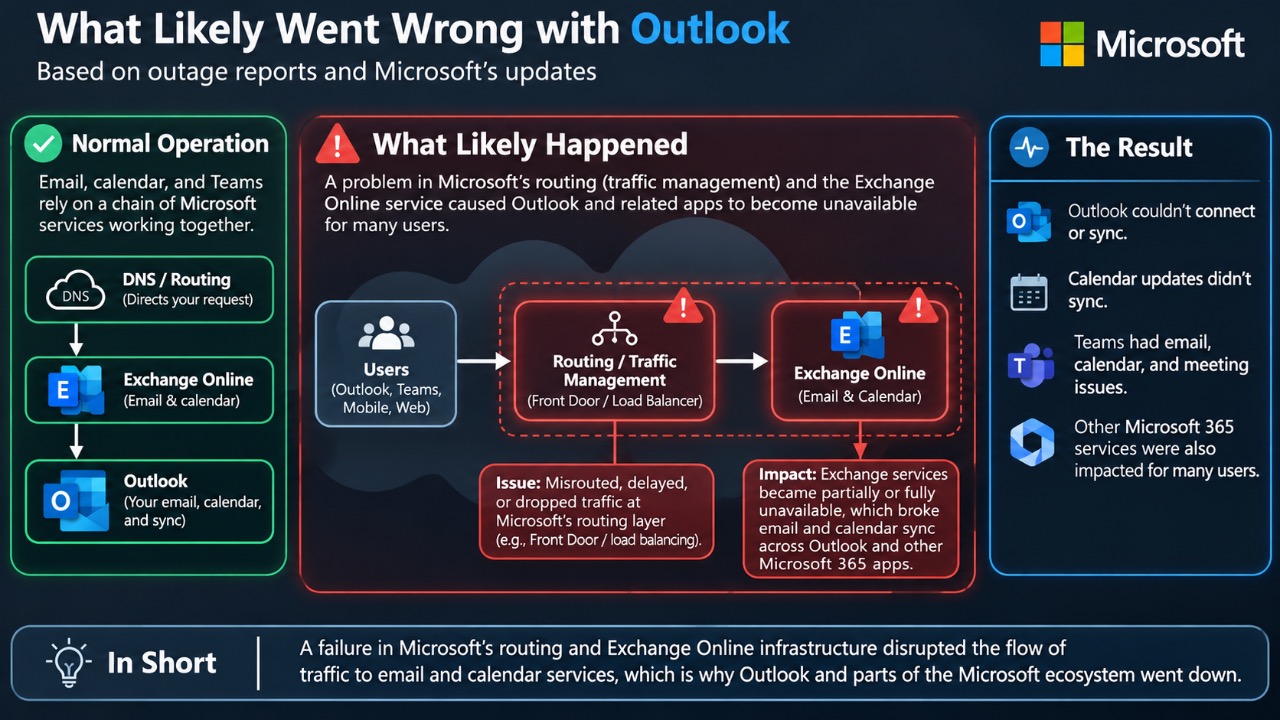
I followed the news to understand how something like this happens at that scale. It appears to have been an issue with their routing and Exchange system.
Like most people, I first thought it could be another cybersecurity failure or attack, like what we have seen over the past few months. At the time, it did not look like that was the case.
It is ironic that this happened on the same day Jensen Huang stepped down as CEO of the largest company fueling technology and AI.
The irony is that one of the most reliable figures in modern technology stepped down on the same day one of the most reliable technology systems in modern history went down. An imperfect human and an imperfect infrastructure.
My lesson from this has levels.
1. With AI and technology, you have to make sure your infrastructure can support the growth. I see many organizations throwing caution to the wind because they really want to get ahead. They forget the basics. Make sure your foundation is right and ready for the load you are growing into. This also applies to our personal lives: if you don't stick to your principles, it takes one moment for trust to disappear.
2. Size doesn't matter. We all are going to face failure. Ironically, my HumanAi™ system had a backup of all my emails and a secondary calendar, so my workflow did not stop. Regardless of size, always have a backup.
3. Nothing is 100% sure. I hear people debate this every day: Apple vs. Microsoft, ChatGPT or Claude, Google Cloud or AWS, open-source or cloud-based models, an experienced executive hired from outside or promoted from within, debt or cash, and I could go on for another 100 examples. The point is that we are all imperfect and have to be ready for anything.
Fortunately, this morning at 7 AM, my reliable Outlook synced, and everything is intact. Because of this, I have decided to create more local backups of all my data and keep going down the path of data sovereignty and securing my infrastructure better. We have become far too reliant on large vendors to guarantee protection as we move into a fully digital world that is getting harder to secure.
Not sure where the next point of failure will be, but I am excited to learn another lesson.
The best moment of the day was when I texted a client who uses Microsoft for everything in his company, especially Teams and Outlook. I asked him: "How did it feel to live half a day without Teams and email?"
His response was epic: "Amazing, but also scary. I got a lot done though!"
Adam
P.S. I handwrote this post about technology. Maybe that can be the next verification that it was not AI written. I am handwriting my new book the same way.